
DEFINITION OF THE RISK CONTEXT
KRC® allows the configuration of processes, roles, layouts, systems, and hazards that will be considered in risk management; the context in which the organization operates is fully captured.
RISK ASSESSMENT
KRC® enables the identification and management of risks by job description, contextualizing each identified risk by process, operations involved, machinery and equipment used, and relevant areas. Risk assessment criteria are defined, and prevention and protection measures are identified and associated, in order to assess inherent and residual risks and produce a comprehensive overview of improvement and adaptation actions. The assessment results serve as input for the Management Review.
MEASUREMENT AND MONITORING
KRC® allows you to manage the measurement and monitoring of each risk, thanks to data models compliant with the regulations (stochastic, measured, modeled, qualitative methods) that guarantee a comparative output with respect to both regulatory and corporate threshold values and allow the monitoring of the related KPIs.
DVR GENERATION
KRC® allows you to generate the DVR Master Document, built starting from the information recorded in the risk assessment process and enriched with contextual information, functional to meet the requirements of Legislative Decree 81/08.

TRAINING – STATE/REGION AGREEMENTS
KRC® allows for the management of mandatory information, training, and education activities, including training for the maintenance of Management Systems, training related to internal operating procedures, and other training activities. It allows for the generation of the Training Plan, attendance/absence register, course reports, certificates of participation, and related KPIs. Course sheets are available for:
- mandatory training, required by the current ASR and updating to the new ASR is expected
- training in the use of equipment and PPE
HEALTH SURVEILLANCE
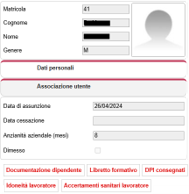
KRC® allows you to produce a health protocol following the risk assessment process by job description and worker qualifications. It creates a schedule of scheduled health visits and check-ups, alerting workers and managing their medical records. It generates and sends the suitability assessment to both the worker and the employer. It generates and graphically displays the relevant KPIs.
DPI
KRC® allows you to manage your PPE catalog, enabling identification and classification, with a dedicated repository of technical data sheets. It allows you to associate PPE with job descriptions, define replacement frequency, and assign distribution responsibilities. It creates a schedule and tracks delivery records, including digital signatures, and can enable connection to automatic distribution systems. It allows you to manage budgets, costs, and related final accounts, and monitor relevant KPIs.
SUPPLIER MANAGEMENT – TECHNICAL/PROFESSIONAL SUITABILITY
KRC® allows you to manage supplier databases, organized by macro-categories, to define applicable technical/professional suitability verification requirements. The user is guided through the pre-qualification and suitability assessment process, up to the generation of the supplier register.
Enables document risk assessment and related treatment plan. Documentation can be uploaded by the supplier via a dedicated portal.
DUVRI
KRC® enables the identification and management of interference risks through the analysis of internal and contractor hazards by area/department and by process. It enables the automated creation of the Master Document by site/area, the Interference Risk Assessment, the identification and association of prevention and protection measures, and the overview of improvement and adaptation actions.
THE ADVANTAGES OF DIGITALIZING THE HEALTH AND SAFETY MANAGEMENT SYSTEM
- Procedure management takes place through optimised and standardised data models.
- The information is automatically propagated between the different modules of the platform, e.g. from training to sustainability, ensuring that the data is entered into a single template..
- The connection of information between the different procedures/flows is carried out following the standard and according to a work optimization logic (guide).
All common factor procedures, to complete the ISO 45001 Management System, are described in the module
Integrated Management Systems