
KRC® ensures the governance, reliability, and accuracy of the data collected, as well as the transparency, traceability,
and verifiability of the various stages of the reporting process. Furthermore, ESG requires extensive digitalization for more efficient organization and medium- to long-term decision-making.
CONTEXT CONFIGURATION AND ESRS DIGITIZATION
KRC® enables complete configuration of the business context and offers a fully digitalized version of the ESRS:
- Material topics
- Disclosure obligations
- Information requirements (Data Point).
The platform's structure is a native guide to the sustainability process, allowing you to immediately launch the reporting project without a preliminary gap analysis and naturally highlighting the information areas to be developed.
ADVANCED WORKFLOW AND DATA GOVERNANCE
The platform centralizes information often distributed between:
- Countries
- Business Unit
- Management systems.
All this through a multi-level approval workflow that guarantees:
- Process consistency
- Traceability
- Effective involvement of company representatives.
DOUBLE MATERIALITY ANALYSIS
KRC® supports the entire analysis process in an integrated way:
Impact assessment
- Financial relevance
- Integration with ERM
- Stakeholder consultation via a dedicated portal.
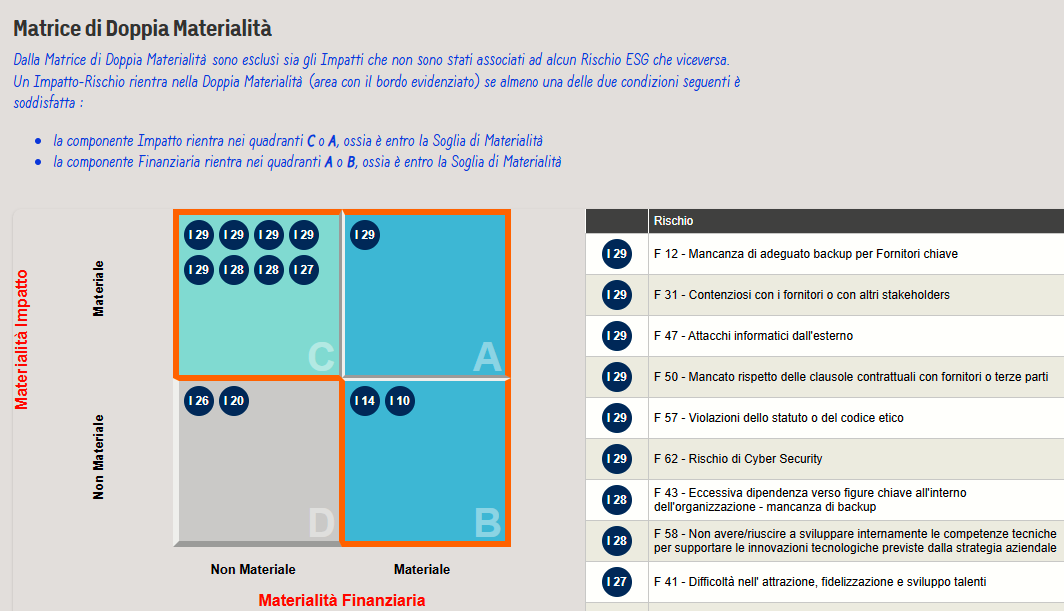
The platform manages materiality thresholds and automatically generates the Materiality Matrix, facilitating collaboration between CSOs and CROs.
.png)
.png)
.png)
.png)
MANAGEMENT OF INFORMATION OBLIGATIONS
Based on the findings of the materiality analysis, the platform:
- Identifies the disclosure requirements to be reported
- allows them to be confirmed or customized
- adapts the disclosure elements to specific company needs.
KPIs, TARGETS AND ACTIONS PLAN
KRC® makes the process measurable and monitorable at every stage:
- supports data collection for KPI calculation
- monitor progress against targets
- allows you to define and manage action plans with responsibilities and deadlines
- allows continuous monitoring of the progress status.
AI AND REPORTING
KRC® produces ESRS-compliant sustainability reports and integrates the management of digital formats, such as XBRL, already used for financial reporting.
Artificial intelligence functions:
- They automate connections between financial and non-financial reporting
- reduce bureaucratic complexity
- enhance the company's real economic, social, and environmental contribution.
.png)
.png)
Read the article DIGITALIZZARE LA SOSTENIBILITÀ: Obbligo o necessità strategica? Due prospettive, un’unica direzione
THE ADVANTAGES OF DIGITALIZING THE SUSTAINABILITY STRATEGY AND REPORTING SYSTEM
The digitalization of the sustainability reporting process facilitates the management of its complexity resulting from the large amount of data required, the transversality and interoperability of the data, and the governance and reliability requirements of the reported information.
The risk assessments produced in the ERM ESG Module are integrated into the dual materiality assessment phase.
The data and information/procedures produced in the ISO 9001, 14001, 45001, 50001, 37001, CSR, and mandatory Management System Modules are integrated into the compilation of the Disclosure Obligations and the calculation of the Metrics.
The sustainability reporting scope corresponds to the Management Systems.